Manuscript Review Policy and Procedure
The journal's article review procedure is double-blind. The algorithm for working with authors' manuscripts is as follows:
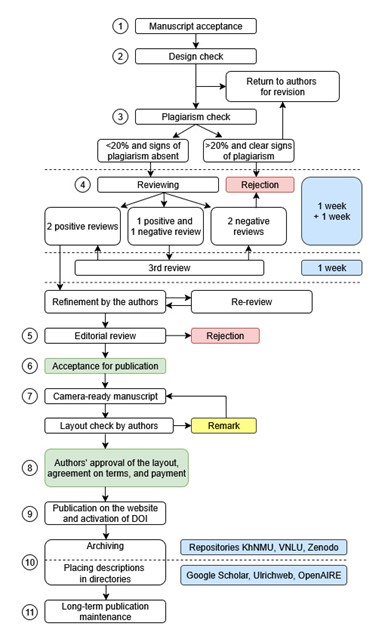
The manuscript is checked for plagiarism. Data about the authors, their affiliation and the place of research are removed from the manuscript. Instead of the full name of the hospital, the treatment profile may be entered (for example, in a surgical hospital). At least 2 reviewers are invited to review each manuscript. If one conclusion is negative and the other is positive, the manuscript is reviewed by a third reviewer. The procedure for working with manuscripts is described in the publication: https://doi.org/10.35339/ekm.2025.94.2.nsd. Reviewers are selected by the editorial board according to their medical specialty and the availability of research on the topic covered in the publication. Reviewers are instructed. The editors inform them about the technology and ethics of review, the possibility/necessity of refusing to review in the presence of a conflict of interest or due to insufficient qualifications. A questionnaire has been developed for review, in which any comments can be written in addition to the questionnaire. This questionnaire is presented in the editorial article: https://doi.org/10.35339/msz.2023.92.1.sha The reviewer's recommendation (publish the article as is; make changes and publish; make changes and submit it to the reviewer again for review; reject the article) is taken into account by the editorial board, but the final decision on publication is made by the editorial board.
Open Access Policy
Authors retain full copyright over their work and grant the journal permission to publish without imposing any restrictions on reuse or redistribution. The journal ensures long-term access to its content by depositing materials in recognized digital preservation archives. Each article is assigned a Digital Object Identifier (DOI) to guarantee permanent accessibility and reliable citation. All articles include embedded machine-readable Creative Commons license information to facilitate proper indexing, reuse, and compliance with open access mandates. Article-level metadata is made available in standard formats to facilitate inclusion in indexing services and aggregators. Authors are permitted and encouraged to place in-press and final versions of published articles in institutional or subject repositories.
Publication Ethics and Malpractice Statement
"Medicine Today and Tomorrow" is a peer-reviewed scientific journal with open access to all articles, focused on adhering to the best practices of evidence-based medicine, the integrity of scientific research and the publication of their results. Every author, editor, reviewer and publisher must adhere to these rules. Control over the implementation of ethical rules is entrusted to the editorial board, which is guided by the guidelines: PEMS, DORA, COPE, WAME, ICMJE, CONSORT. In cases of identified misconduct or the creation of conflict situations, the editorial board takes measures ranging from issuing warnings to authors and reviewers to terminating cooperation with them completely.
This section contains:
- principles used by the editorial board in its work
- publication authorship and author contributions
- procedure for submitting complaints and appeals
- conflict of interest policy
- journal policy on data sharing and reproducibility
- ethical oversight
- legitimate use of others' intellectual property
- post-publication discussions
- corrections to published articles
- retraction of published articles
- combating plagiarism and citation manipulation
- counteraction against data falsification and fabrication
The editorial board operates based on the principles of transparency, accessibility, diversity, equality, and inclusivity. When considering a publication, only the intellectual content of the described research is taken into account; the gender, race, sexual orientation, or religious beliefs of the authors are not considered. However, under the conditions of war with russia, the editorial board does not consider manuscripts from authors from russia and belarus, as prohibited by the laws of Ukraine. All other authors are prohibited from citing in their articles sources published in russia and belarus, as well as referencing sources published in russian.
Journal advertising and sponsorship do not influence editorial policy. The editorial board acts as an arbiter in scientific disputes between authors and reviewers and also plays an educational role in matters of publication ethics, especially for researchers who are just beginning their scientific careers.
The editorial board adheres to the principle of confidentiality in preserving authors' information. Under exceptional circumstances, the editorial board may share minimally necessary information with editors of other journals, institutions, and other organizations investigating cases of ethical violations and other wrongful actions in research. Unpublished materials disclosed in a submitted manuscript must not be used in the personal research of editors and reviewers without the written consent of the author(s). Authors' ideas obtained during peer review are kept confidential and are not used by the editorial board or reviewers for personal gain. Reviewers must not share their review or information about the article with anyone or contact the authors directly without the editor's permission.
Publication Authorship and Author Contribution are determined by clear criteria to ensure that only those individuals who have made substantial intellectual contributions are credited. Only a person who has made a significant contribution to the research can be considered an author: to its conception, design, data collection, analysis, or interpretation; participated in drafting or critically revising the text; approved the final version; and bears responsibility for the work's integrity. Individuals who do not meet these criteria may receive acknowledgment for research assistance in a separate section. For each article, a specific description of each author's contribution using standard roles is mandatory.
Responsibility for the correct list of authors lies with the corresponding author submitting the manuscript. Any changes to authorship after manuscript submission require the written consent of each author and an explanation to the editorial board. Any disputes regarding contributions must be disclosed to the editorial board. Non-compliance with this policy may lead to manuscript rejection, article retraction, or other sanctions. The copyright holders of published articles (authors) are indicated in the full text of all articles (PDF).
Consideration of allegations of scientific ethics violations is conducted with the involvement of editorial boards, and in specific cases, at joint meetings of editorial boards and editorial councils. The procedure for submitting complaints and appeals is as follows: within two weeks after the author(s) are notified of cases of publication ethics violations identified by the editorial board, the author(s) must indicate in writing their disagreement with the editorial board's conclusion and present facts in defense of their position. The editorial board considers the author(s)' appeal within one month and informs in writing its final decision to resolve the matter in favor of the author(s) or the imposition of penalties (rejection of the article; retraction of a published article; termination of cooperation with the author(s), etc.).
The conflict of interest policy requires all participants in the publication process (authors, reviewers, and editors) to fully disclose any financial, professional, or personal interests that may affect their objectivity or be perceived as doing so. Such interests include direct or indirect financial relationships, existing patents, personal connections, academic competition, or intellectual bias. This information must be provided during submission and will be published with the article if accepted, ensuring transparency for readers.
The existence of a conflict of interest requires measures to minimize its impact. Upon receiving such disclosure, the editorial board decides how to handle the situation: this may involve assigning the material to another editor, engaging independent reviewers, or other mechanisms to preserve the impartiality of the assessment. Concealing a potential conflict of interest is considered a violation of scientific ethics and may lead to manuscript rejection, refusal of further cooperation, or retraction of an already published work. If a manuscript is submitted by a journal editor, it is handled by another editor on a general basis, with plagiarism checks and peer review using a double-blind procedure.
Any existing or potential conflicts of interest may be declared by the editorial board in the text of publications, communicated to authors in writing during manuscript preparation, and updated if new conflicts arise.
Journal policy on data sharing and reproducibility encourages authors to openly share the data, software code, materials, and methodologies underlying their research to promote scientific transparency, verification of results, and reproducibility. Authors are recommended to upload relevant datasets to recognized repositories upon manuscript submission and provide links to them in the article. For empirical, experimental, and computational work, it is necessary to provide a sufficiently detailed description of methods so other researchers can reproduce the obtained results. The journal encourages, and in some cases requires, the submission of supplementary materials or publication of pre-registration protocols for experimental studies. Non-compliance with these principles may affect the decision to accept the manuscript for publication.
Authors of original research should be prepared to present an accurate report of the work performed, objectively discuss its significance, describe the research with sufficient detail and references to allow others to replicate the work, provide data for editorial review or public access during article preparation and for a reasonable time after publication.
Ethical oversight, particularly obtaining approval from an appropriate ethics committee or institutional review board, is a mandatory requirement for all research involving humans, animals, tissue samples, or personal data. The manuscript must clearly state the protocol number and name of the ethics committee that granted permission for the study or explain the reason for exemption from such approval. For research involving humans, informed consent from all participants must be confirmed. In work with animals, adherence to principles of humane treatment and minimization of suffering in accordance with current national and international standards must be described in detail. Non-compliance with these principles is a serious violation of scientific ethics and grounds for immediate rejection of the material.
The journal's policy on intellectual property is based on respect for ownership rights, legal practice of agreements, and adherence to national and international legal norms. The very fact of submitting a manuscript to the editorial board implies that the authors guarantee they possess the necessary rights to use ideas and images, have permissions from owners of third-party content or agreements for its use, which must be communicated to the editorial board. Authors grant the publisher consent for the first publication of their article under the terms of the Creative Commons Attribution-NonCommercial-ShareAlike 4.0 International License for distributing the published article and a public contract. Use of others' images requires written permission from their owners, with the exception of lectures. All borrowed quotes, images, and ideas must be properly referenced. Violations of these rules, license terms, and agreements for using others' intellectual property are investigated by the editorial board, may lead to legal consequences, and article retraction.
The journal supports post-publication discussions as an important tool for scientific progress and correction of published data and encourages readers to express constructive comments related to published materials through official communication channels, such as correspondence with the editorial board and the publication of reviews of published articles. In case significant errors or inaccuracies that do not affect the overall conclusions of the research are identified, a correction (erratum) is published at the authors' initiative or by the editorial board's decision, clearly referencing the original article. If serious violations of scientific ethics, data fabrication, plagiarism, or irreparable errors that undermine the reliability and value of the published work are identified, the article may be retracted with a corresponding notice explaining the reasons, which remains permanently linked to the original publication to ensure the integrity of the scientific record.
Retraction of a published article may be caused by the discovery of a fact of gross ethical violation (falsification of research results, plagiarism, violation of intellectual property rights, concealment of conflict of interest, etc.). The editorial board and publisher disclaim responsibility arising from such violations. The editorial board annuls the publication of the article, which is announced in the next issue of the journal as a separate publication. The galley proofs of the retracted article on the journal's website are replaced with analogous ones crossed out in red. Article publication charges (APC) are not refunded to authors.
The editorial board ensures the detection, investigation, and resolution of violations of scientific ethics. To detect plagiarism, the editorial board uses professional text originality checking software for all submitted manuscripts. A qualified editor makes the decision regarding the presence or absence of plagiarism. The approximate threshold for borrowings properly referenced to primary sources is set at 20%.
Combating citation manipulation is a critically important component of editorial policy. The journal strictly prohibits the practice of coercive or unjustified increases in the number of references to the journal's publications, its editors, or reviewers to artificially influence bibliometric indicators. Reviewers are prohibited from demanding that authors include citations of their own works in the absence of objective scientific grounds arising directly from the manuscript's context. All recommendations regarding citing additional sources received from reviewers are subject to mandatory verification by the editor for compliance with scientific relevance. Systematic detection of citation manipulation may lead to article retraction and refusal of further cooperation with authors who violate these principles. The only acceptable method for authors to work with sources is studying them and providing proper citations. Irrelevant references to sources selected randomly for a prepared text, as well as references to non-existent sources, are considered a violation of author ethics.
To counteract data falsification and fabrication, the editorial board relies on expert assessment of methodology and analysis and encourages authors to disclose primary data. If suspicions of possible falsification arise, the editorial board initiates a formal investigation: contacts the authors for explanations and necessary documentation, and in complex cases, contacts the institutions where the research was conducted. If convincing evidence of a violation exists, the article is retracted with an unambiguous explanation of the reasons in the retraction notice, which remains permanently accessible. The editorial board is also prepared to cooperate with other journals and organizations such as COPE, for coordinated actions in complex cases of misconduct, ensuring transparent communication with the scientific community about the consequences of violations.
Policy of Generative AI Use
Authors bear full responsibility for the originality, veracity, and proper authorship of the intellectual content presented in the manuscript. The use of generative artificial intelligence (AI) to perform creative and analytical tasks that are essential to scholarly work is unacceptable and constitutes a breach of academic integrity.
In accordance with the Generative AI Delegation Taxonomy (GAIDeT, 2025), authors are prohibited from delegating any of the following core tasks to generative AI tools: the generation of research ideas, hypotheses, or conceptual frameworks; the writing, reorganization, or paraphrasing of any part of the manuscript text, including the abstract, sections, conclusions, and figure captions; the search, selection, analysis, synthesis, or interpretation of scientific literature for the purpose of creating a literature review or justifying the research. The use of AI for these purposes is equated to uncredited authorship and plagiarism.
The permitted use of generative AI tools is limited to auxiliary, technical purposes that do not affect the intellectual substance of the work. Such permissible uses include: checking grammar, spelling, and punctuation; formatting citations and the reference list according to the journal's requirements; improving the clarity and readability of text already written by the author without altering its scientific meaning; translating the author's own original text into the language of publication.
Authors are required to fully disclose any use of generative AI in the manuscript preparation process in a dedicated section titled "Declaration of AI Use." This section must clearly specify the name of the tool used, its version, provider, and the precise manner of its application at each stage of the work. The absence of such disclosure or the provision of false information constitutes a severe violation of editorial policy and will result in the rejection of the submission or the retraction of a published article.
Advertising Policy
The journal is open to advertising proposals. All advertisements placed on its pages and website must comply with the requirements of the Law of Ukraine "On Advertising". The journal does not consider proposals for the advertisement of alcoholic beverages, tobacco products, homeopathic medicines, weapons, or gambling.